Search This Blog

Wednesday, September 29, 2010

Acapella High Violoncello II loudspeaker


Stereophile's founder, the late J. Gordon Holt, always had a thing for horn loudspeakers, feeling that these archaic beasts offered a "jump factor" that could never be rivaled by conventional, direct-radiating designs. A horn drastically increases the efficiency with which electrical power is converted into acoustic power, which means that for a given sound-pressure level, a smaller amplifier can be used compared with a direct-radiator, and that all distortions, both electrical and mechanical, can theoretically be much lower. Yet outside of a small circle of enthusiasts, horns never got much of a following in high-end audio, and as high amplifier power became plentiful and relatively cheap, horns largely disappeared from domestic audio use (except in Japan).


A horn acts as an acoustic transformer, converting the high acoustic impedance of a direct-radiating diaphragm to a much lower impedance better suited to excite the air load—which is why, more than a half-century ago, in the heyday of low-powered tube amps, horns were ubiquitous. But there are practical limitations to the increase in efficiency offered by a horn: at low frequencies, its output will depend on the diameter of the horn at its widest and at high frequencies, reflections of the sound from the opening will lead to coloration. For the best sound quality, therefore, a horn needs to be used over a relatively narrow passband, which in most circumstances is impractical. In the past, horns have been used over too wide a bandwidth, hence their reputation for "honky," colored sound.

In recent years, developments in the physical design of horns, especially in the cases of the biradial horns from JBL and Klipsch, along with careful implementation and use, have all but banished the coloration bugbear. Two German companies, Avantgarde and Acapella, have also worked hard in the past 20 years to make use of the potential for sound quality offered by horns. Avantgarde was first to market in the US, and Stereophile has reviewed and recommended several of that company's models. But I have been impressed by the sound produced by the Acapella designs at recent audio shows, and approached the brand's US distributor about a review. We settled on the High Violoncello II ($80,000/pair) as being most suitable for my room.

The Acapella High Violoncello II
This beautifully finished speaker is a large, three-way floorstander. Its rectangular enclosure, 50" tall and substantially constructed, houses three 11" treated paper-cone woofers, one of which internally loads the other two in isobaric fashion. Each of these has a substantial half-roll rubber surround and a stationary phase plug on the front of the pole-piece. Though the fact that the woofer enclosure is raised from the ground by the plinth with its four corner pillars, the enclosure is sealed rather than reflex-loaded by a downward-firing port, as its appearance might suggest. A V-shaped notch in the top of the enclosure embraces the midrange enclosure, which is secured with large Allen-head bolts fore and aft. (The front bolt also secures the woofer grille.) A 2" soft-dome midrange drive-unit is loaded with a large, circular horn that has what appears to be an exponential flare. Its bell is 18.5" (470mm) in diameter. The drive-unit's backwave is absorbed by the filling of the midrange enclosure, which is both massive and acoustically inert.

Below the midrange horn, the top 12" of the woofer enclosure is open to the rear, above the sealed compartment for the drive-units. The separate Ion TW1S tweeter module, housed in a perforated metal box and powered with its own AC cable, sits within this section. Viewed head-on, the metal box is hidden by the continuation of the front baffle; all that is visible is the distinctive 6"-diameter brass horn that loads and amplifies the tweeter's output.

The tweeter module is a completely self-contained unit, accepting a line-level input from an RCA jack and amplifying the signal with a class-A amplifier. What is unusual about this tweeter is that it has no mechanical diaphragm. Instead, an intense radio-frequency electrical field ionizes the air between two electrodes to produce a distinctive, violet-tinged yellow flame in the quartz combustion chamber at the base of the horn. The RF field is modulated by the audio signal, causing the almost massless flame to expand and contract in what should be a perfectly spherical pistonic manner, producing sound that is then coupled to the outside world with the 9"-long brass horn. The upper limit of the ionic tweeter is indeterminate but is arranged by Acapella to be at least 40kHz. As well as the AC inlet and the RCA jack, the rear of the module carries three fuses and a rotary tweeter-level control. Internal adjustments are provided for the crossover frequency, control of the flame conditions, and the automatic turn-on voltage (set at the factory for 30mV at 1kHz). Full details of the TW1S, which is also available separately, can be found here.

Sunday, September 26, 2010

Lights in a Box?

"Without content, television is nothing more than lights in a box."
---Edward R. Murrow.
Steve Guttenberg---Con
Steve Guttenberg has been a projectionist for 21 years, working in movie theaters and (from 1984 to 88) at WPIX-TV in New York City. He has 15 years' high-end retail experience at Sound by Singer, also in New York, and since 1988 has served as a producer for Chesky Records.

The high-end community is a tiny, fragile island---albeit an influential one---in the vast consumer electronics/entertainment world. This island was left mostly undisturbed by the larger outside world until the early 1990s, when Home Theater became the new cause célèbre of the electronics biz. This market has grown so quickly that it may endanger music-only systems, which I believe are what the overwhelming majority of Stereophile readers enjoy on a regular (daily) basis.

Because I believe that the goals of Home Theater and the High End are mutually exclusive, I pose these questions: Can they coexist in the same community? Do the retailers and manufacturers who cater to the high-end market wish to accommodate a mid-fi approach to sound quality? Will those manufacturers of high-end equipment who lower their sights to address the Home Theater market find their high-end customer base losing interest in their products? Do they really believe Home Theater is the only way to increase sales?

My position is not against Home Theater per se; it's that the High End can prosper on its own terms. The word on the street is that Home Theater is booming; most high-end dealers I spoke to claim 50% of their 1995 sales were in some way Home Theater-related.

The High End is a quest for the unobtainable: to create the perfect illusion of live music in the home. Home Theater strives to re-create the cinema experience at home, but this effort is considerably hampered by the NTSC video standard (footnote 1). Most videophiles believe that the digital soundtrack on laserdiscs is of CD sound quality; in practice, it's far below CD standards. I performed some LD/CD/LP comparisons that produced a serious indictment of Home Theater's sound quality. Home Theater is a mid-fi picture and sound medium. Yes, it can be fun, but it's not High End.

Home Theater (the marriage of audio and video) is a cancer that endangers the High End and all it has worked to achieve. My concern is that small audio companies (average size: 15-20 employees) will divert their precious R&D away from what should be their first priority: the quest to transport the listener back to the recording session.

We've come a long way, but the goal of creating an illusion of real musicians performing between our (two!) speakers remains elusive. To now redirect our attention to a lower-resolution format (AC-3, DTS, or MPEG-1 and -2) is to abandon the notion of creating the "perfect illusion" of music in the home. I don't understand why anyone who's experienced the sheer musical pleasure of a great high-end system would accept the crude mid-fi of even a top Home Theater setup. Yes sir, cheap thrills abound: explosions, dinosaur feet pounding away, spacecraft swooping overhead---all synthesized effects designed to rattle your eardrums. Visceral, you bet---but close your eyes and listen to how real it sounds. It's in no way comparable to a decent LP or CD enjoyed over a good high-end system.

Friday, September 24, 2010

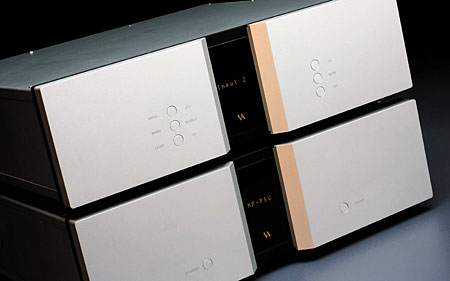
Vitus Audio MP-P201 Masterpiece Series phono preamplifier


This massive, two-box beauty from Denmark costs $60,000, and I wish I could tell you it wasn't really better in most ways than the already outlandishly priced and sonically superb Boulder 2008. I can't.


No one spends this kind of money on a phono preamp unless its appearance and functionality are commensurate with its sound, and in the MP-P201 they are—even if there's only the RIAA curve, and no Mono button. However, what will get wealthy enthusiasts to drain $60k from their bank accounts will be the Vitus's unmistakably astonishing sound. Plug it in, play it, and compare it with whatever you own, and unless you are a confirmed tubeaholic, if you've got the krone, prepare to shell out. Designer Hans-Ole Vitus claims that this method has already sold more than a few units of his mundanely named product.

The Vitus includes switchable, independently configurable balanced and single-ended inputs and a single balanced output. Pushbuttons select and save input sensitivity (125–500µV for MC) and loading for each input, the name of which can be selected from a list of 10 popular cartridge brands—or, in Text mode, you can enter your own.

Vitus offers a choice of four dealer-installed modules for resistive loading, only one of which can be installed at a time. Each includes 16 different resistances,. Two are MC only, and two offer both low impedance loading and 47k ohms, for those who have MC and MM cartridges. No alternate capacitive loadings are offered, but really—how many buyers will use an MM cartridge with a $60,000 phono preamp?

Oh, no!
In direct comparisons with the Boulder 2008, the Vitus MP-P201 produced more of everything that anyone would want to hear from a solid-state phono preamp—and for twice the price but with considerably less functionality, it had better well! The first late evening I spent with it had me yelling, loudly and often, to no one in particular, "Are you f***ing kidding me?"


Just when I thought the dynamic and spatial potentials of an LP had been fully expressed, just when I thought the resolution of inner detail of the other top contenders I've heard had revealed all that was engraved in the grooves of some overly familiar vinyl, the Vitus proved me so wrong. Even casual listeners—such as my skeptical next-door neighbor, who visits periodically to hear the latest insanity—exclaimed profanely when he heard his requests through the Vitus.

Often, great amplifiers are described as "gripping" and "holding" the loudspeakers. The Vitus MP-P201 did that to the signal coming from the cartridge as no other phono preamp has in my experience. That effect rippled through the signal chain, improving the performance of everything it touched, and finally tightening its grip on the speakers themselves. It wasn't at all subtle—as a visiting speaker manufacturer heard the other day. Nor did it sound too mechanical or dry or "electronic"—though again, if you primarily value the continuousness and flow of tubes, while you'll be respectful of what the MP-P201 achieves, you might not be as impressed as I was.

The MP-P201's dynamic presentation at both ends of the scale was nothing short of ridiculous. Its bass extension, control, and weight were granitic. Its ability to tonally and spatially retrieve and resolve instruments and voices within a narrow frequency band produced a constant barrage of new information from some very familiar recordings.

Unexpected voices and instruments appeared in three-dimensional space from the most familiar recordings. These familiar recordings are almost part of my DNA, so suddenly hearing something completely new and obvious produced many "WTF" moments. Even after having sat mesmerized by that Shostakovich LP through both Boulders, hearing it now through the Vitus MP-P201 was yet another revelation of what's possible from vinyl playback specifically, and from musical reproduction in the home in general. The Vitus drew a line in the sand of its soundstage that produced images of the fronts of orchestras way back in space, with an unprecedented solidity and certainty of location. Every aspect of the spatial picture was equally solid and convincing, including the front-to-back layering of orchestral sections—even though this Melodiya/EMI is a very distant recording.

Nor did such a degree of delineation sound artificial. It sounded as natural as when I hear the New York Philharmonic in Avery Fisher Hall, with imaging, soundstaging, and depth just as easily audible—not as compartmentalized musical workstations, but as part of an organic whole that some skeptics claim doesn't exist when you hear symphonic music live. It does.


The Vitus MP-P201's speed, transparency, three-dimensionality, frequency extension, rhythmic ability, musical grip, and any other parameter you could name—with the exception of what only tubes can do—took the overall sound to a new, exalted level. That Shostakovich performance sounded as convincingly "live" as I've ever heard from a recording—except through the Ypsilon VPS-100 tubed phono preamp ($27,700), which I reviewed in my August 2009 column.

If you can look yourself in the eye and spend $60,000 on a phono preamp, you need to hear Vitus Audio's MP-P201. You need to hear it even if you haven't got the $60k—just so you know what awaits you, should you strike it rich.

Tuesday, September 21, 2010

Gradient Helsinki 1.5 loudspeaker


By Art Dudley • August, 2010
A clever engineer with an interest in home audio says that the real obstacle to high-fidelity sound is the adverse and unpredictable way in which speakers interact with most domestic rooms. To address that need, he brings to market a loudspeaker that disperses sound in a new and original way. Controversy ensues. Controversy endures.
So it was with Amar Bose, of Bose Corporation, in 1965. So it is with Jorma Salmi, of Gradient Ltd., in 2010.


For all that, Amar Bose's model 901 loudspeaker and Jorma Salmi's Helsinki 1.5 ($6500/pair) are as different as night and day. Whereas the Bose 901's acoustical output is mostly projected away from the listener and toward the boundaries of the listening room, the Helsinki 1.5, which is made in Finland by Gradient Ltd., aims to disperse as much sound toward the listener's ears as possible, thus minimizing the room's effect on playback. That, as Robert Frost might say, has made all the difference.

Description
A family portrait of Gradient products from 1985 to the present (click here) shows six loudspeakers that aren't so much similar as they are similarly strange. A vertical ribbon atop a woofer cone bestows on one model an expression of perpetual surprise, like an exclamation point, while another model resembles a one-eyed character from the Pixar film Monsters, Inc. One is tall and has 22 front-firing drivers; another is short and has only two. And so it goes.

On closer examination, it's easy to imagine that most of those distinctions relate to Jorma Salmi's prime directive: to design and build loudspeakers whose performance is neither hampered by nor dependent on their surroundings. Judged by appearances alone, the Helsinki 1.5 looks more purposeful still—as if the newest Gradient speaker is a purer distillation of the ideas that made their debut in the oldest.

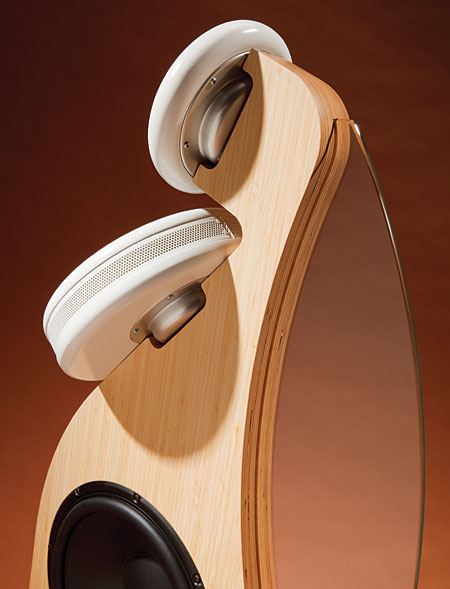
Central to the Helsinki 1.5 is a flat, multi-ply frame carved into a graceful shape, which tapers from bottom to top, like an abstract G-clef. The frame is machined from what appears to be a bamboo laminate roughly 2.25" thick, and is fastened to a shield-shaped base of glass; the feet are three domes of soft polymer. A second sheet of glass forms a sort of dorsal fin, the purpose of which may be to mitigate dipole cancellation of the output of the side-firing woofer, which is bolted firmly to the bamboo frame. That 12" woofer, made by Peerless, has a paper cone that's rough on one side and smooth on the other.

The Helsinki's 5" midrange driver, made by SEAS, has a paper cone, a soft rubber surround, and a molded frame. It fires from the front of its own specially shaped enclosure/baffle, ca 11" in diameter and 3" deep, with a perforated rim: it looks not unlike an old-style automotive air-filter housing. The front and back portions of the enclosure are molded from a plaster-like material, and the interior is stuffed with soft acoustic foam. The driver and enclosure are fastened as one to the front edge of the Helsinki's frame—the axis of the midrange driver is perpendicular to that of the woofer—and aimed well above the listener's head, at an approximate 45° angle to the floor. The idea, of course, is to prevent early (floor) reflections of upper-bass and lower-midrange tones, and the unwanted comb-filter effects they produce.

The bottom edge of a somewhat smaller (7.5" diameter) enclosure for the high-frequency driver obscures the top edge of the midrange baffle, and addresses the listener at a less drastic angle. The aluminum-dome tweeter, also made by SEAS, measures 0.75" in diameter, and is mounted on the baffle from the rear; the whole shebang is fastened to a 6"-diameter stamped metal dish, itself screwed to the bamboo frame. A small, thin pad is fitted between baffle and frame.

Signal connections to the Gradient Helsinki 1.5 are made through a Neutrik Speakon socket, at least partly because the speaker's narrow wooden frame can't accommodate a stereo pair of more common connectors. Tim Ryan of SimpliFi Audio, which distributes Gradient speakers in the US, makes available a Speakon-to-banana-or-spade adapter for $150 each; bereft of such a thing, the prospective owner could buy a pair of Neutrik plugs (part no. NL4FX-9) and use them to reterminate his or her cables of choice. Incidentally, because the Speakon is a four-pole connector, it could conceivably support biwiring through a single plug, though I didn't try that.

Home Audio Sales on the Rise

By Jason Victor Serinus
September 2, 2010 — According to a recent Consumer Electronics Association's (CEA) press release, "CE Industry to Surpass $174 billion in 2010, Reach Record High by 2011," sales forecasts are far more optimistic than had been expected. While the figures aren't easily translatable to the high-end market (which the CEA identifies as "high-performance audio"), some consumer-electronic (CE) trends give cause for qualified optimism, and provide clues as to which products may prove most profitable for manufacturers and dealers.
At the start of 2010, the CEA predicted that total CE revenues would be down 7.8%, and that the industry's rate of growth would slow to 0.3%. In actuality, thanks to strong holiday-season sales at the end of 2009, the actual drop in revenues was 6.5%, or nearly $170 billion in total US factory-to-dealer sales.

The CEA now expects CE products to generate total US factory sales of $174 billion for 2010, yielding an annual growth rate of 3%—hardly the doom-and-gloom scenario predicted by many. (Source: U.S. Consumer Electronics Sales and Forecasts 2006–2011, CEA, July 22, 2010.)

A second market-research report from the CEA, the 12th Annual Household CE Ownership and Market Potential Study (May 2010), indicates that average CE household spending was $1380, an increase of 12% over 2009. Women spent an average of $631, and men $969. The biggest group of spenders was those aged 25–34, while people older than 55 tended to spend the least. The biggest spenders were families with children, and households with incomes exceeding $75,000.

While HDTVs and digital cameras top the list of products households intend to purchase in 2010, large CE spenders in particular plan to focus on smartphones, notebook computers (and spinoffs), and HDTVs. While 23% of households may be banking on a new HDTV or digital camera, a solid 18% are looking at a Blu-ray player, portable MP3/digital media player, or docking station. The CEA projects that, by the end of 2011, 59% of households will own paired speakers (front, side, or rear), 51% an iPod or other MP3/digital audio player, 43% a docking station for an MP3 or other portable digital player, and 41% at least one subwoofer.

After reporting on and interpreting the data, Sean Murphy, the CEA's Senior Account Manager, Market Research, spoke with Stereophile by phone. "With relative confidence, based on what we're seeing and hearing, I think there is cause for optimism," he said. "We've been hearing doom and gloom for several years. Almost every category was down, and home audio was feeling the effects of the massive migration to digital files and earbuds—a cheaper solution for audio. If you were computer-savvy, you could convert your entire home library for free.

"My personal opinion is that the demographic for speakers and CD players and boutique products will continue. There's always a demographic that wants those things. But for the short run, the so-called lower-level, Best Buy receivers are up, and we didn't see that six months ago. It stands to reason that, after virtually everyone has gotten an MP3 player and flat-panel TV that they are probably satisfied with, they're now ready to augment their audio."

In addition to Murphy's analysis, the data point to several products whose relatively strong sales are of great interest to the High End: MP3/digital audio players, which continue to proliferate in households; and Blu-ray players, which seem to be driving strong sales of home-theaters-in-boxes. These imply great sales potential in several categories. The first is the iPod dock, either standalone (eg, Wadia's 170i iPod dock, which bypasses the iPod's built-in DAC; and their 171i, which turns an iPod or iPhone into a high-end media server), or built into existing products such as integrated amplifiers, CD players, DACs, and self-powered computer speakers.

The second category is multiformat players that include Blu-ray. Products such as the Oppo Digital BDP-83 and 83SE, upgrades to same, and spinoffs from Ayre Acoustics and Theta Digital come to mind. With Naxos poised to begin releasing high-resolution audio recordings on Blu-ray, the format's popularity should definitely increase in some segments of the high-end market.

The third category is media servers, USB and FireWire DACs, and USB- FireWire-to-S/PDIF links that allow audiophile-level playback of digital files.

It's important to note that most of the 74 manufacturers that contributed data for the CEA's forecast are not high-end companies. Even those that do cater to audiophiles, including Marantz, Monster, Polk Audio, Audio Technica, Sony, and Thiel, also produce mass-market and home-theater products. Nonetheless, the data are useful as indicators of which areas may prove most profitable for manufacturers and dealers whose main focus is high-end audio.